Not All Baby Gates Are Safe for the Top of the Stairs. Here's the One That Is.
Disclosure: As an Amazon Associate I earn from qualifying purchases. This page may also contain other affiliate links. If you buy something through a link here, we may earn a commission at no extra cost to you. We only recommend products we've researched and believe are genuinely useful. See our privacy policy for details.
Why “any gate” isn’t good enough for stairs
A gate that’s fine for a doorway can be dangerous at the top of a staircase. If a pressure-mounted gate meant for flat walls gets bumped hard, it can pop loose. At a doorway, that’s a scare. At the top of the stairs, that’s a fall.
That’s why the safest gates for stairs are labeled hardware-mounted, stair-rated. That means they bolt into the wall or banister with actual screws, not just tension. Some gates can do both jobs (pressure OR hardware), but you want one that lets you hardware-mount at the top of the stairs specifically.
The problem with most “hardware mount” gates
Even gates that claim to be hardware-mountable often assume you have two flat walls to screw into. Real staircases don’t cooperate:
- Banisters are round or angled, not flat like a wall.
- Openings are wider than standard doorways, especially at the top of a staircase where two hallways meet.
- Newel posts (the big post at the top of the stairs) are often too fat for standard mounting brackets.
If a gate can’t handle any of these, you end up jamming a doorway gate into a stairway opening and hoping for the best. Don’t do that.
Our pick: Cumbor 30-46” Baby Gate
This is the gate we actually installed at the top of our own stairs. Two things make it work where a lot of cheaper gates fail.

It opens wider. The Cumbor stretches to fit openings up to 46 inches, well beyond the 29-38 inch range you get on most basic gates. That extra width matters at the top of a staircase, where the opening is often wider than a standard door.
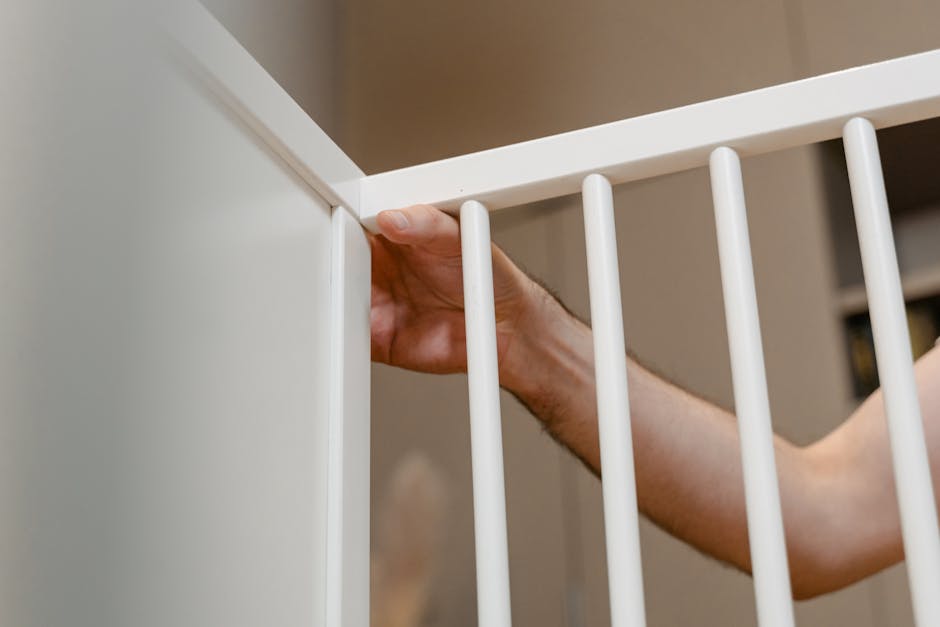
It mounts on round and angled posts. The included mounting kit has extension pieces designed for curved banisters and angled walls, not just flat drywall. That’s the exact spot where most stair gates fail to install at all.
It supports both mounting styles. You can pressure-mount it for a quick setup somewhere low-stakes (like a doorway between rooms), or hardware-mount it for the top of the stairs, where you want it bolted in, not just wedged in place.
Who this is for
This is our value pick, not a premium splurge. There isn’t a “big spender” upgrade we’re pointing to here: the Cumbor gate already covers the two things that trip up more expensive gates (wide openings and odd-shaped posts) at a lower price than a lot of the competition.
For the money-conscious: this is the whole recommendation. You don’t need to spend more to get a properly stair-rated gate. Check your opening width and post shape first, and this gate covers the widest range of real-world staircases without needing separate add-on kits.
Quick checklist before you buy any stair gate
- Measure your opening width at its widest point, including any trim.
- Check your post shape. Round banister, square post, or angled wall corner all need different mounting hardware.
- Confirm it’s labeled for stair use, not just “pressure mount for doorways.”
- Plan to hardware-mount at the top of stairs, even if the gate can also pressure-mount elsewhere in your house.
Get those four things right and you’ve solved the part of babyproofing that actually matters most: the top of the stairs.